


An early look at one of the main content items in Mid-Atlantic Thoroughbred magazine's April edition. You can see the full edition soon here.
By Sean Clancy
Standing room only. United and strong, concerned citizens and racing enthusiasts turned out at Buchanan Hall in Upperville, Va., to address a local issue with national impact March 4. The United States Army recently announced it was pursuing the purchase of the storied Middleburg Training Center.
The facility, once home to Spectacular Bid, Hoist the Flag, Go for Gin in a long history, has served as the state’s most productive public training facility. If the sale went through, it would eliminate 11 barns, 220 stalls, 22 paddocks and a 7-furlong dirt track from the Thoroughbred equation in Virginia – and decimate the Virginia Certified Program, which has contributed to the revitalization of the sport in the state.
Philanthropist, sportsman and Thoroughbred owner/breeder Paul Mellon constructed the training center in 1956. In 1975, he sold to a group of local trainers which included Paul Fout and Lewis Wiley. In 2006, Randy Rouse purchased it before donating it to the Thoroughbred Retirement Foundation. Unable to manage a training center, the TRF sold it to Chuck Kuhn, founder of JK Moving Services, in 2017. Kuhn put the property into conservation easement and refurbished the track and barns.
The 149-acre facility has provided an important base for a host of trainers including Cary Frommer, Madison Meyers, Chris Kolb, Neil Morris and Barry John Foley.
Based on 64 acres just down the dirt road from the training center, Centennial Farms has used the training center to educate its horses since 1986. Champion sprinter Rubiano, and Belmont Stakes-G1 winner Colonial Affair called the place home, as did Wood Memorial-G1 winner Wicked Strong, Met Mile-G1 winner Corinthian, Woodward-G1 winner Preservationist, Jockey Club Gold Cup-G1 winner Antiquarian and this year’s Holy Bull Stakes-G3 winner Nearly.
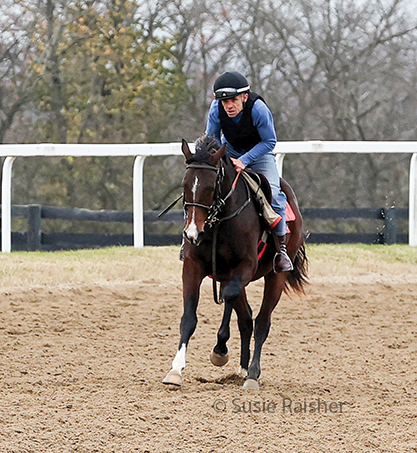
A leading 3-year-old early in 2026, Nearly goes through some paces on the Middleburg track in 2024.
“Every single one,” Centennial’s Don Little Jr. said. “Every single one.”
Bred in Florida by Wind Hill Farm, Nearly fetched $350,000 at the Keeneland September yearling sale in 2024. Selected by Dr. Steve Carr and the Centennial team, pre-trained by Paula Parsons in Middleburg, and now trained by Todd Pletcher, the son of Not This Time finished sixth in his debut at Aqueduct in October, broke his maiden by 9¼ lengths at Gulfstream Park in November, added an allowance race by 5 lengths at Gulfstream in January, and made it three in a row with a 5 3⁄4-length decimation job in the Holy Bull Jan. 31.
Nearly is nearly there.
Firmly a part of early opinion lists and leaderboards, the bay colt eyed the Florida Derby-G1 Saturday, March 28 as his next step toward the Kentucky Derby-G1 May 2. He is part of a nine-horse field in the 1 1/8-mile race worth $1 million. He will have to deal with Fountain of Youth-G1 winner Commandment from the barn of Brad Cox and runner-up Chief Wallabee from Bill Mott, but can take Centennial – and Virginia – to Kentucky on the first Saturday in May with a strong performance. Post time for the Florida Derby, the day's 14th race at Gulfstream Park, is 6:42 p.m. Eastern. See Equibase entries.
“It’s a great feeling. Once again, he’s a nice horse who has gone through the Virginia residency program,” Little said the day of the town-hall meeting. “We hope for the best. He’s doing well. We’ve got a lot of nice partners who have been with us for quite some time and are due to be rewarded and hopefully it will happen. It’s always a delicate road but it’s exciting to be on it.”
Parsons and Centennial made Nearly’s map in Middleburg. His lane was always clear.
“Nearly was absolutely – and don’t take this lightly – a perfect horse,” Parsons said in mid-March. “He never had a bump on him, never had filling in a leg, never had to be stopped for anything. He was natural in the gate the first day. He was a lady’s ride.”
After the Holy Bull win, Parsons’ foreman Juan Gallegos remembered how straightforward the process was.
“You do realize we never had to stop that horse for anything,” he told Parsons. “He never got a shin, he never got sick, he never had filling in a leg or anything.”
Gallegos wasn’t the only one impressed. Groom Mario Chavez and riders Aoife Brazil and Alexis Rios-Conde were also part of the team that guided the colt along the way. Nobody predicted Derby potential – they just saw quality and helped it develop.

Paula Parsons supervises training after Alexis Rios-Conde has hacked his next mount over to the training center.
“I’ve had horses – like Corinthian, Wicked Strong, a few others – that walked on their hind feet more than they did on all four, that were always a handful,” said Parsons. “He was a perfect gentleman and he was so pretty that in an Upperville-show-horse kind of way, I remember thinking, ‘Well, if he has to come back to the farm and I have to rehome him, I’ll have to get him to some show-horse people.’ I guarantee you he snaps his knees too.”
That can wait, probably forever, but Parsons credited two things with helping raise such a horse.
First, people. Gallegos, who learned from Hall of Fame trainer Frank Whiteley, has worked there 30 years for example. Assistant and exercise rider Brazil has been part of the team for almost 21. Rios-Conde, Gallegos’ brother Juan and others fill important, long-standing roles too.
“I am so fortunate to have them,” said Parsons. “They deserve so much credit for Nearly’s success. And the Centennial people are wonderful owners and allow their trainers to do what’s best for the horse – no pressure to hurry up.”
Second, the environment. The horses start in the stall and the shedrow like pretty much everyone else’s, then things change a little. Horses hack between paddock fences and do early work in a field along Goose Creek before ever seeing a racetrack. When they do head to the adjacent training center, they take a 10-minute ride on a bridle path complete with squirrels, birds, raccoons, deer, hawks and light car traffic on the other side of a buffer.
By the time horses get to the track on any given day, they are warmed up, settled down – and ready for work. The walk back to the barn helps horses decompress from the exercise and the lessons about lead changes, steering and competition. A typical set at Centennial takes at least a half-hour.
“When they get to the track, they feel like they’ve seen it all,” Parsons said of the route. “The downside is that what’s good for an individual horse means that it does take my riders a little longer. I’d have trouble using a freelance rider for the simple reason of the time. In an hour they’d get on two for me and five for somebody else.
“But that’s the way it is, if you want to do it right, it takes the time.”
And a place like Middleburg. The potential sale to the Army leaves the future in doubt for Centennial and other Thoroughbred operations that use the facility.

The barns at Middleburg Training Center could house U.S. Army caisson horses if a sale goes through.
“We haven’t talked about where we would go,” said Little. “I would imagine we would shut down the operation there and do like everybody else, go to Florida. It would have to be the right scenario because our training methods are a little bit different than the typical Florida training method. Up and down the hills, nice walk to the training track. We are old-school horse people, and we believe in that.”
Centennial buys six to eight yearlings each year, concentrating on colts with deep pedigrees in hopes of scoring on the racetrack and scoring bigger in the stallion market. The individualized approach, the quieter setting, the hills, the hacks play a crucial role in the program.
“We don’t buy that many and we still get results that people notice,” Little said. “It would be detrimental. It would be massive. It’s home, really. Once we were there, it’s been great. Colonial Affair was a Virginia-bred. Rubiano was a Virginia-bred. What the VTA and the VEA have done, bringing it back. It’s a big deal for the us, it’s a big deal for the economy.”
Little’s father, Don Sr., started Centennial Farms in 1982 after a sales pitch gone wrong. The scion of racing partnerships, Cot Campbell, pitched Dogwood Stable to Little. He didn’t bite. Well, he bit on the concept, just not on Dogwood.
“The whole thing started when we were playing polo in Aiken. That’s how we met Steve because he was playing polo,” Little Jr. said. “Dad went to Steve and said, ‘You know, there’s this guy down here who’s been bugging me. He’s driving me nuts. Why don’t we go buy a horse on our own?’ So, they did, they bought a $50,000 horse at the Belmont training sale. He got some Wall Street buddies involved. And that’s how it started.”
And it continued.

The Centennial Farms facility is adjacent to the Middleburg Training Center in Virginia.
Carr has been picking out the horses ever since. Parsons joined the team when they purchased the Middleburg farm in 1986. Little Jr. began part time in 1987 when the partnership concentrated on fillies and became full time in 1990, changing it to a colts-only model.
Don Little Sr. died from injuries sustained in a fall while competing in a horse show at Wellington 2012. Donald Little III works with Centennial and his younger brother, James, plans to get involved as well. That’s three generations. All from one base.
“Dad came across Paula at the Maryland sale. Dad the Chatty Cathy he was, said, ‘I’m thinking about buying a farm.’ She said, ‘I think I know of a spot.’ He was fox hunting down there, he knew Zohar [Ben-Dov], Jim Treptow,” Little said. “I was still playing professional polo. When I quit polo, I said, this is what I wanted to do. He backed me and here we are. We never really changed much. We stuck to the old format, old school, deep pedigrees, skip generations, the old pedigree analysis. It works. It works.”
In Middleburg.
With the possibility of the U.S. Army buying the historic facility for its Caisson Detachment of horses used in state funerals and other military ceremonies, the Virginia racing industry faces a threat while one of its graduates inches closer to the sport’s highest honor.
“There are places you could build a track, but people aren’t going to do that. We don’t have the infrastructure to do that. Hopefully it will work out,” Little said. “As for Nearly, yeah, it’s pretty cool. Those three races have been something else. Yeah, you get excited, but you’re excited more for the people. What would it be like? It would be huge. It would be a big feather. We’ve got a lot of feathers in our cap and that’s the toughest one to get.”
Additional reporting and writing by Joe Clancy.
